Reflector in Human Design: A Practical Guide
Explore Reflector chart definition, the lunar strategy and practical questions for making decisions.
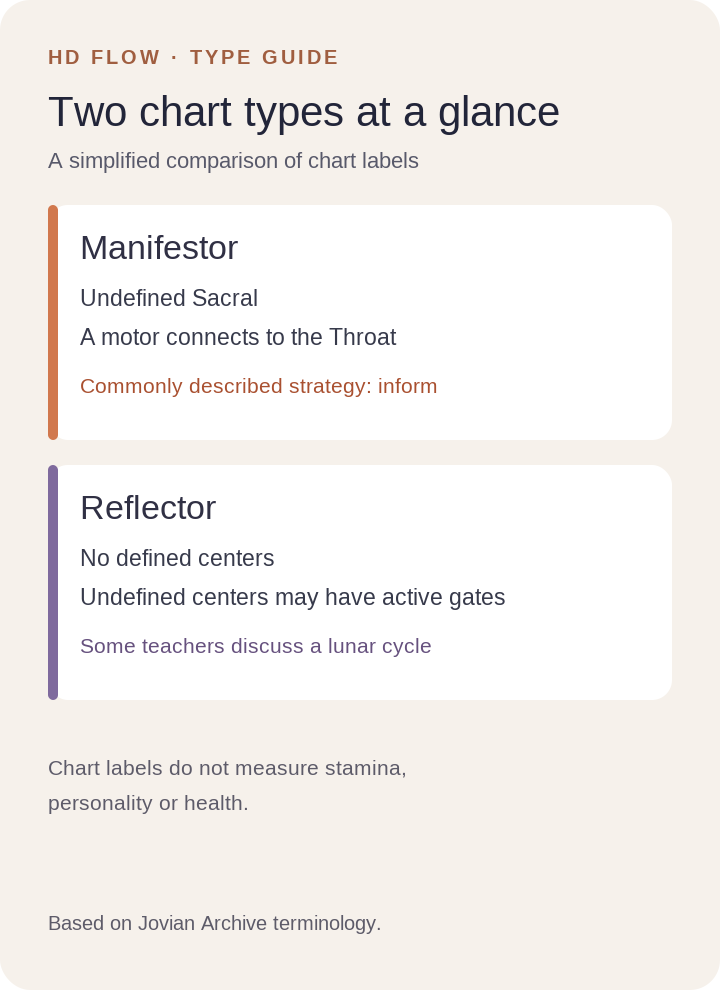
Short answer: In Human Design, a Reflector chart has no defined centers. Teachers often discuss considering significant decisions over a lunar cycle; this is a practice within the system, not a scientifically established requirement.
A chart does not determine a person's health, stamina, identity, emotions or ability to make decisions.
What makes a Reflector chart?
A Reflector has no complete defined channels and therefore no defined centers in the birth chart. An undefined center may still contain activated gates; “completely open” is commonly used for an undefined center with no activated gates. A Reflector chart does not require all nine centers to have zero activated gates.
| Type | Chart distinction in Human Design |
|---|---|
| Reflector | No defined centers |
| Projector | Undefined Sacral, at least one defined channel, and no motor connected to the Throat |
| Manifestor | Undefined Sacral and a motor connected to the Throat |
Centers, Gates and Channels explains the chart terminology. See open and undefined centers.
What does the lunar strategy mean?
Some Human Design teachers suggest reflecting on major decisions over a lunar cycle, described by different sources as about 28 or 29 days. A person may find journaling or taking time useful, but no chart establishes a required waiting period or guarantees an answer.
Astronomical cycles differ: the Moon orbits Earth relative to the stars in about 27.3 days, while new moon to new moon averages about 29.5 days, according to NASA. See the Reflector lunar cycle guide for the distinction.
You can make everyday decisions, ask for help, apply for work and choose within the time available. Never delay urgent medical care or a safety decision to wait for a lunar cycle.
Environment and identity
Human Design teachers sometimes use “sampling” as a metaphor for the influence of surroundings. Comfortable spaces and supportive relationships can matter to anyone, but a chart does not prove that you absorb another person's emotions, become your environment or lack a stable identity.
If something feels wrong, consider the circumstances and talk with people involved. A chart is not a diagnostic tool for a person or community.
A practical decision example
If you are considering a move, you might:
1. Identify the decision and the deadline. 2. Compare rent or purchase costs, location, accessibility and support. 3. Visit if practical and ask questions about the area. 4. Discuss the choice with anyone affected. 5. Choose using the information and time available.
You can journal or revisit your notes if useful. Waiting longer does not guarantee a better choice.
Disappointment, rest and relationships
Human Design associates disappointment and surprise with Reflector themes. Those labels do not establish the cause of an emotion or predict what will happen next.
A chart does not determine sleep needs or require you to sleep alone. For persistent sleep or health concerns, seek qualified care. See Human Design and sleep and relationships.
Frequently asked questions
Does a Reflector have no energy?
No. A chart's undefined centers do not establish how much stamina or energy a person has.
Is every Reflector center completely open?
Not necessarily. A Reflector has no defined centers, but an undefined center may still have activated gates.
Must I wait 28 days for a decision?
No. This is a Human Design reflection practice, not a requirement. Use the time appropriate to the situation.
Can I calculate my chart here?
Use the free Human Design chart calculator to calculate your chart in your browser. A birth-time estimate can make some results provisional.
Sources and related reading
- Centers, Gates and Channels and The Four Types, Jovian Archive.
- Top Moon Questions, NASA.
- Reflector lunar cycle and open centers, HD Flow.
See this in your own chart
Reading about the mechanics is one thing — seeing them mapped onto your own bodygraph is what makes it click. Your free chart shows your type, strategy, authority, profile, defined centers, channels and gates.