Reflector Lunar Cycle: Human Design and Decision Timing
Explore the Reflector lunar strategy, the difference between lunar cycles, and practical options for making decisions.
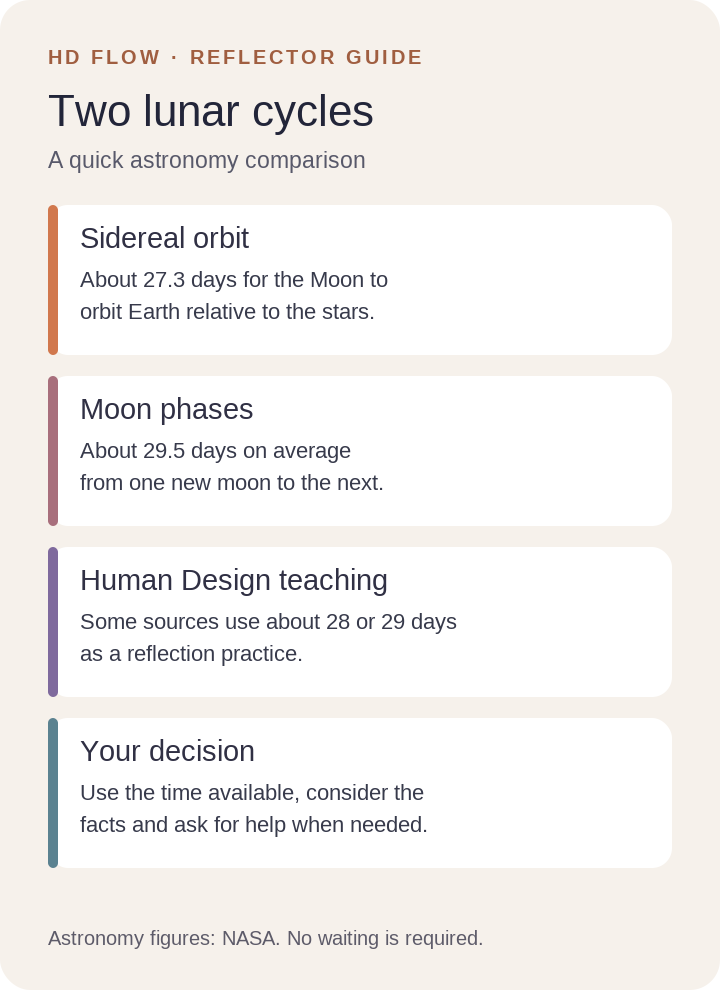
Short answer: Human Design describes a Reflector as a chart with no defined centers. Some teachers suggest considering major decisions over a lunar cycle, often described as about 28 or 29 days. This is a Human Design practice, not a scientifically established requirement or a reason to postpone urgent care.
A chart does not determine your health, stamina, personality or ability to make decisions. The lunar language is part of an interpretive framework.
What is a Reflector?
Within Human Design, a Reflector has no defined centers in their birth chart. This does not mean that the person has no consistent qualities or cannot make decisions. See the Reflector guide and what Human Design is for an introduction.
Human Design teachers use the phrase “sampling” to discuss changing experiences and environments. Treat this as a metaphor within the system, not proof that you absorb other people's emotions or can diagnose a community's health.
Why do some sources say 28 days?
Jovian Archive's authority guide describes a Reflector practice of waiting about 28 days for major decisions. Other Human Design pages use about 29 or 29.5 days. These are descriptions of the teaching, not a precise rule established by research.
In astronomy, the Moon takes about 27.3 days to orbit Earth relative to the stars; the cycle from one new moon to the next averages about 29.5 days, according to NASA. The two measurements describe different cycles. A fixed 28-day interval should not be presented as the exact length of either one.
How might reflection work in practice?
For a non-urgent decision, you can take a flexible approach:
1. Write down the decision and deadline. What needs to be decided, and when? 2. List the practical details. Consider cost, risks, alternatives and who is affected. 3. Check in over time if useful. Notice whether you have new information or different priorities. 4. Talk with trusted people. They can help you consider options; they do not have to decide for you. 5. Choose in the time available. A shorter period may be appropriate, and waiting longer does not guarantee a better outcome.
You do not need a lunar calendar to use these steps. If tracking the Moon is meaningful to you, it can be a journaling prompt; it does not establish what choice is right.
What if the deadline is shorter?
Ask whether a deadline can be extended, but make the best decision you can with the time available. You do not need to wait a month to apply for work, communicate with someone, seek help or make an everyday choice.
Never delay urgent medical care, emergency assistance or safety decisions while waiting for a lunar cycle.
Environment, sleep and wellbeing
A comfortable environment and supportive relationships can matter to anyone. No chart establishes that a Reflector becomes their environment or must sleep alone to recover. Sleep problems, persistent fatigue or concerns about mood deserve appropriate healthcare rather than a chart-based explanation. See Human Design and sleep.
Frequently asked questions
Does a Reflector have to wait 28 days for every decision?
No. That period is a teaching some people use for reflection on significant choices, not a requirement for everyday or urgent decisions.
Is a lunar month exactly 28 days?
No. The Moon's orbital period relative to the stars averages about 27.3 days, while the new-moon-to-new-moon phase cycle averages about 29.5 days.
Can a Reflector chart reveal another person's health or emotions?
No. A chart is not a diagnostic tool and cannot establish what another person feels.
Can I calculate my chart on HD Flow?
Use the free Human Design chart calculator to calculate your chart in your browser. A chart based on an estimated birth time should be treated as provisional.
Sources and related reading
- What Is Inner Authority?, Jovian Archive.
- Top Moon Questions, NASA.
- Reflector type and the sleep guide, HD Flow.
See this in your own chart
Reading about the mechanics is one thing — seeing them mapped onto your own bodygraph is what makes it click. Your free chart shows your type, strategy, authority, profile, defined centers, channels and gates.