Open and Undefined Centers in Human Design: What They Mean
Learn the difference between defined, undefined and completely open centers and explore their themes as reflection prompts.
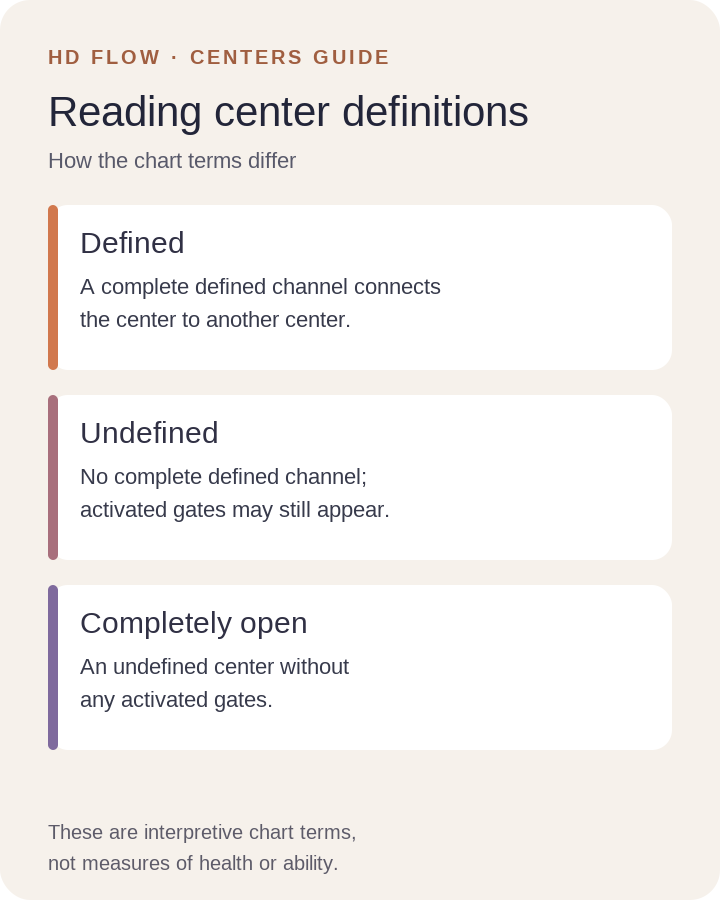
Short answer: Human Design uses “undefined” for a center that is not defined by a complete channel. A completely open center is undefined and has no activated gates. These describe a chart, not a person's intelligence, health, personality or ability.
Some Human Design teachers use “open” loosely for any undefined center, while others distinguish a completely open center. Jovian Archive explains the more specific distinction.
Defined, undefined and completely open
| Term | Meaning within Human Design |
|---|---|
| Defined center | A center connected by a complete defined channel. |
| Undefined center | A center without a complete defined channel; it may contain activated gates. |
| Completely open center | An undefined center with no activated gates. |
Neither defined nor undefined means better, broken or deficient. Display colors can differ by chart theme, so use the chart's legend and gate markings.
What do the nine centers represent?
Human Design associates each center with themes. The descriptions below are part of the system's teaching; they are not medical or psychological measurements.
| Center | Commonly described theme |
|---|---|
| Head | Questions and inspiration |
| Ajna | Concepts and thinking |
| Throat | Communication and expression |
| G | Identity and direction |
| Heart / Ego | Will and resources |
| Solar Plexus | Emotions |
| Sacral | Activity and response |
| Spleen | Instinct and awareness |
| Root | Pressure and momentum |
Explore the centers overview and defined versus undefined Sacral. Different teachers may describe these themes differently.
Do open centers absorb someone else's emotions?
Human Design teachers may use the language of influence or amplification. There is no established evidence that a chart proves an emotion came from someone else. Mood and stress can be affected by many circumstances, and asking people directly is more reliable than assuming how they feel.
A center's name does not diagnose an illness or indicate how well a physical organ functions. Seek professional help for persistent symptoms or mental health concerns.
What is “conditioning”?
In Human Design, conditioning is a term used for influence from other people or surroundings. Some people use it as a prompt to consider habits and expectations. It does not establish that a partner's chart causes your feelings, that you must sleep alone, or that a particular center is responsible for a decision.
A useful question for anyone might be: “Is this expectation actually helping me?” Consider your circumstances and the available evidence.
A practical reflection exercise
1. Pick a theme, such as work pressure or communication, that you want to think about. 2. Describe a specific situation instead of assuming the chart explains it. 3. Ask what you need. More information, rest, a boundary or support may be helpful. 4. Choose an appropriate next step. Seek medical, mental health or other professional support when relevant.
A reflective question can start a conversation; it is not a diagnosis or a rule. Urgent medical and safety decisions should not be delayed for chart interpretation.
Frequently asked questions
Is an undefined center the same as a completely open center?
Not always. A completely open center is undefined with no activated gates. An undefined center may have activated gates.
Is an open center a weakness?
No. It is a chart label and does not establish a weakness or a person's capabilities.
Do I need to sleep alone because I have undefined centers?
No. A chart does not determine the right sleeping arrangement. See the sleep guide.
Can HD Flow calculate my chart?
Use the free Human Design chart calculator to calculate your chart in your browser. An estimated birth time may produce provisional results.
Sources and related reading
- Centers, Gates and Channels and The Nine Centers, Jovian Archive.
- Centers overview, Sacral guide, and sleep guide, HD Flow.
See this in your own chart
Reading about the mechanics is one thing — seeing them mapped onto your own bodygraph is what makes it click. Your free chart shows your type, strategy, authority, profile, defined centers, channels and gates.