Human Design Relationships: Composite Charts and Compatibility
Understand common partnership chart terms, their limitations, and practical ways to talk about relationships.
Short answer: Human Design partnership or composite charts combine elements of two birth charts. Some people use them to start conversations about relationships, but a chart has not been scientifically established as a way to predict compatibility, attraction, conflict or safety.
Respect, communication, consent and boundaries matter regardless of chart type. You can explore the system without treating its labels as verdicts about either person.
What is a composite chart?
A composite, connection or partnership chart displays selected chart elements from two people together. A reader may compare defined centers, activated gates and channels. Jovian Archive describes four common channel labels.
These labels describe chart patterns in Human Design teaching. They do not establish how two people feel about each other or who is responsible for a disagreement.
Four common channel terms
| Term | Pattern described in Human Design |
|---|---|
| Electromagnetic | One person has one gate of a channel and the other person has its connecting gate. |
| Compromise | One person has the full channel while the other has one of its gates. |
| Dominance | One person has the full channel and the other has neither gate in that channel. |
| Companionship | Both people have the same full channel. |
Teachers offer interpretations of these patterns, but a channel label does not prove attraction, dominance in a relationship or a particular conflict. Different chart services may use different language or presentation.
Can Human Design predict compatibility?
No. A chart cannot establish whether a relationship will succeed, whether someone will be a good partner, or whether a situation is safe. Any combination of types may build a relationship that works for them; actual behavior and circumstances matter.
If a description resonates, ask your partner whether it matches *their* experience. Avoid telling someone what they feel or using a chart to excuse hurtful or controlling behavior.
Questions that can start a conversation
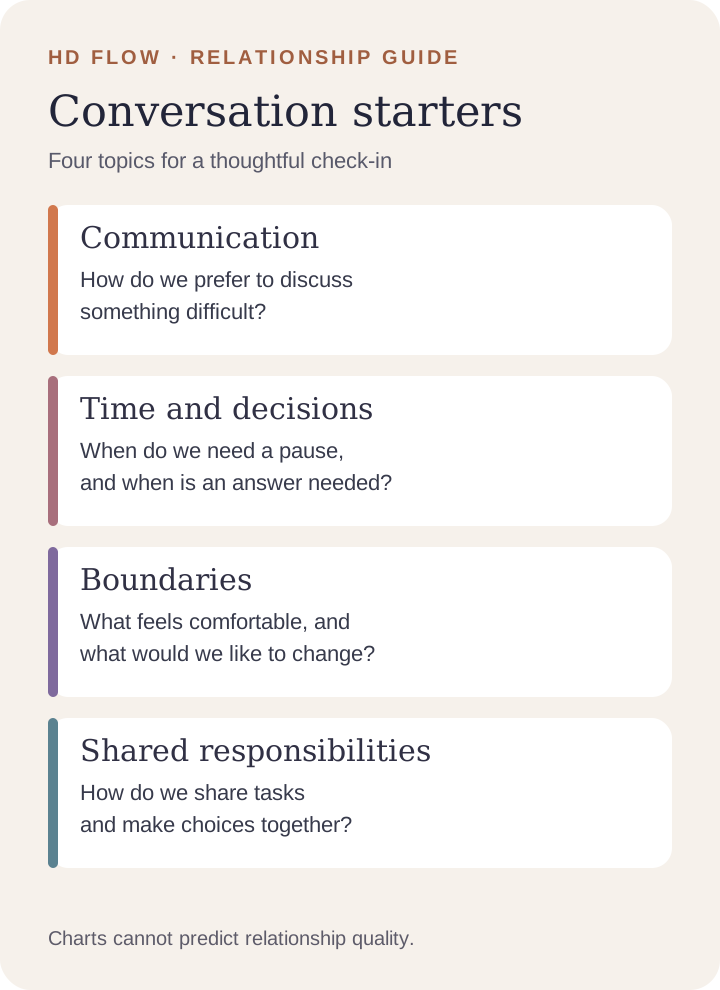
1. Communication: How do we prefer to discuss a difficult topic? 2. Time: When does each person want a pause, and when do we need an answer? 3. Boundaries: What feels comfortable, and what would we like to change? 4. Practical life: How do we share responsibilities and make decisions? 5. Repair: What helps us address a misunderstanding respectfully?
The National Domestic Violence Hotline's healthy relationship guide discusses mutual respect, communication and boundaries. Consent is ongoing, and either person can change their mind.
What about strategy and authority?
Human Design assigns strategies and authorities to charts; some people find those descriptions useful to discuss. They do not require a partner to wait for a lunar cycle, ask for an invitation, or give an overnight deadline. Each person can express preferences, negotiate timing and make their own choices.
Do not delay urgent medical care or safety decisions for a chart reading. If you feel unsafe, seek appropriate support from people or organizations you trust.
Privacy and birth details
Birth dates, times and places are personal data. Ask permission before entering another person's information into a service, and check its privacy practices. Use the free Human Design chart calculator to calculate your chart in your browser.
Frequently asked questions
Does an electromagnetic channel guarantee attraction?
No. It is a chart pattern in Human Design, not evidence that attraction or compatibility will occur.
Does a dominance channel mean someone controls the relationship?
No. The label describes a channel pattern; it does not establish real-world behavior or excuse controlling conduct.
Can partners with different types have a healthy relationship?
Yes. Chart types do not determine relationship quality. Mutual respect, communication, consent and individual circumstances matter.
Sources and related reading
- Understanding Partnerships with Human Design, Jovian Archive.
- Healthy Relationships and Consent, National Domestic Violence Hotline.
- Human Design compatibility and what Human Design is, HD Flow.
See this in your own chart
Reading about the mechanics is one thing — seeing them mapped onto your own bodygraph is what makes it click. Your free chart shows your type, strategy, authority, profile, defined centers, channels and gates.