Human Design Gates and Channels: A Beginner's Guide
Understand the 64 gates and 36 channels with a worked 34–20 example and explanations of defined channels and hanging gates.
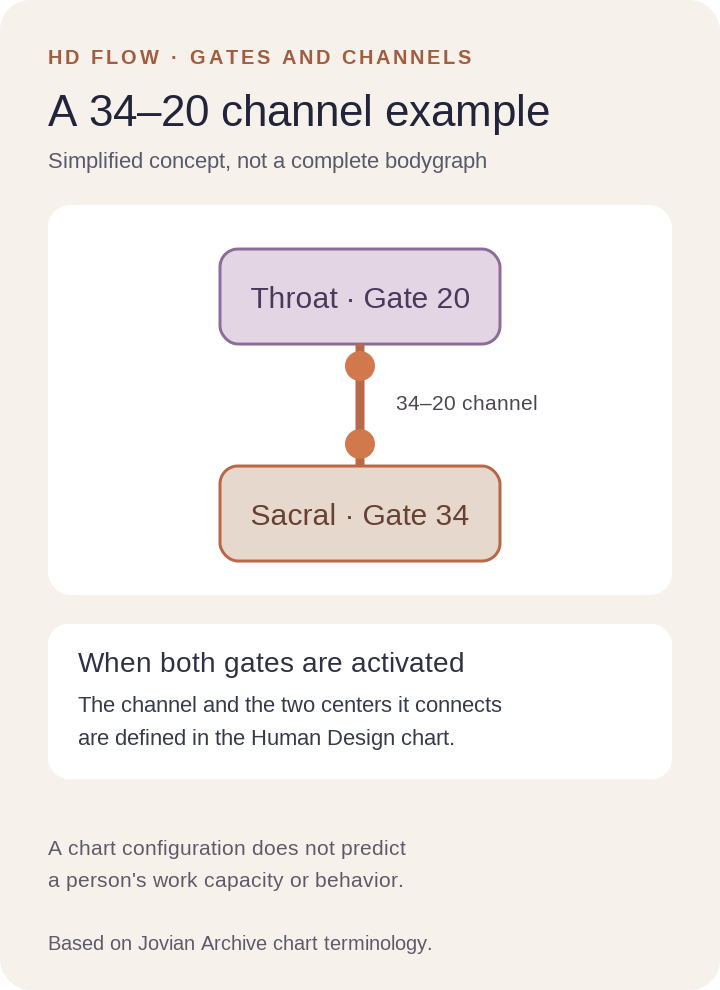
Short answer: Gates are numbered points on the centers of a Human Design chart; channels connect pairs of gates. In the system, when both gates at the ends of a channel are activated, the channel and the two centers it connects are defined.
Human Design is an interpretive framework. Its gate and channel meanings are not scientifically validated measures of personality, health, attraction or ability.
The parts at a glance
| Term | Meaning in Human Design |
|---|---|
| Center | One of nine shapes in the bodygraph. |
| Gate | A numbered point on a center; the system uses 64 gates. |
| Channel | A connection between two gates; the system uses 36 channels. |
| Defined channel | A channel whose two end gates are both activated in the individual chart. |
| Hanging gate | An activated gate whose connecting gate is not activated in that individual chart. |
Jovian Archive's centers, gates and channels guide explains how the pieces connect. See the bodygraph overview for the broader chart.
How do gates become activated?
A Human Design chart uses birth details to calculate two sets of planetary positions. The Personality set corresponds to birth; the Design set uses an earlier point defined by 88 degrees of solar longitude, roughly three months earlier. It is not necessarily exactly 88 calendar days.
Many charts use black for Personality, red for Design and combined markings when both apply. Display colors can vary, so check your provider's legend. Those labels do not establish that a trait is consciously known or genetically inherited.
A worked channel example: 34–20
Gate 34 is at the Sacral Center and Gate 20 is at the Throat Center. If both are activated in an individual chart, the 34–20 channel is defined, connecting those centers. Jovian Archive uses this example in its chart-reading guide.
If only one end is activated, that gate is often called a hanging gate for that channel. One activated gate alone does not necessarily define its center; another complete channel could define the same center.
Do hanging gates predict attraction?
No. Some Human Design teachers discuss an “electromagnetic” pattern when two people have connecting gates across their separate charts. That is a way of describing a composite chart, not evidence that two people will feel attraction, complete each other or have a healthy relationship.
For the four common partnership terms, see Human Design relationships.
What are circuits?
Human Design groups channels into broader families commonly called Individual, Tribal and Collective circuits. Teachers assign themes to these groupings. The labels can be interesting to explore, but they do not determine how you behave or what you should do for work or relationships.
How to read an existing chart
1. Check the legend. Colors and layouts can vary. 2. Find a gate number on a center and trace its connecting channel. 3. Look at the other end. Are both gates shown as activated? 4. Check the centers. A complete defined channel defines both centers it connects. 5. Explore the interpretation as an optional prompt, not a diagnosis or rule.
If your birth time is estimated, some chart results may change. Use the free Human Design chart calculator to calculate your chart in your browser.
Frequently asked questions
Does one activated gate define a center?
Not necessarily. A defined center is connected by a complete defined channel; that channel may be a different one from the gate you are looking at.
Are gates and channels the same thing?
No. Gates are numbered points on centers; channels are the connections between pairs of gates.
Do gate labels tell me what career to choose?
No. Consider your interests, skills, circumstances and evidence about an opportunity. A chart does not establish the right career.
Sources and related reading
- Centers, Gates and Channels, Jovian Archive.
- How to Read Your Human Design Chart, Jovian Archive.
- Bodygraph basics and open centers, HD Flow.
See this in your own chart
Reading about the mechanics is one thing — seeing them mapped onto your own bodygraph is what makes it click. Your free chart shows your type, strategy, authority, profile, defined centers, channels and gates.