Projector Recognition and Invitation: A Practical Guide
Explore recognition and invitation in Human Design, with practical questions for evaluating opportunities and everyday decisions.
Short answer: Human Design describes a Projector's strategy as waiting for recognition and invitation in significant areas of life. Jovian Archive discusses relationships, career and major decisions; it does not say to wait for an invitation for every daily action.
Human Design is an interpretive framework, not a scientifically validated measure of personality, stamina or decision-making. Treat its language as a prompt for reflection rather than a rule for your life.
What do recognition and invitation mean?
In Human Design teaching, recognition means being seen or acknowledged for what you bring. An invitation is an opening to participate, contribute or consider a commitment. A job offer, a request for advice or an invitation to collaborate can be examples, though teachers may use these terms differently.
An invitation does not guarantee that someone understands you or that the opportunity is suitable. You can ask questions, negotiate, decline or change your mind. Being noticed by a person or employer is not proof that an arrangement will be healthy.
When might the idea be useful?
| Situation | A practical question |
|---|---|
| Someone asks for advice | What kind of help are they actually looking for? |
| A possible job or collaboration | What are the responsibilities, pay, boundaries and options? |
| A new relationship or living arrangement | Do I feel respected, and do our expectations fit? |
| An everyday choice | What do I want or need, and what information do I have? |
You can apply for a job, start a project, meet people, express interest and ask for help. You do not need an invitation to participate in your own life. Applying for work does not prevent you from evaluating an offer later.
How to evaluate an invitation
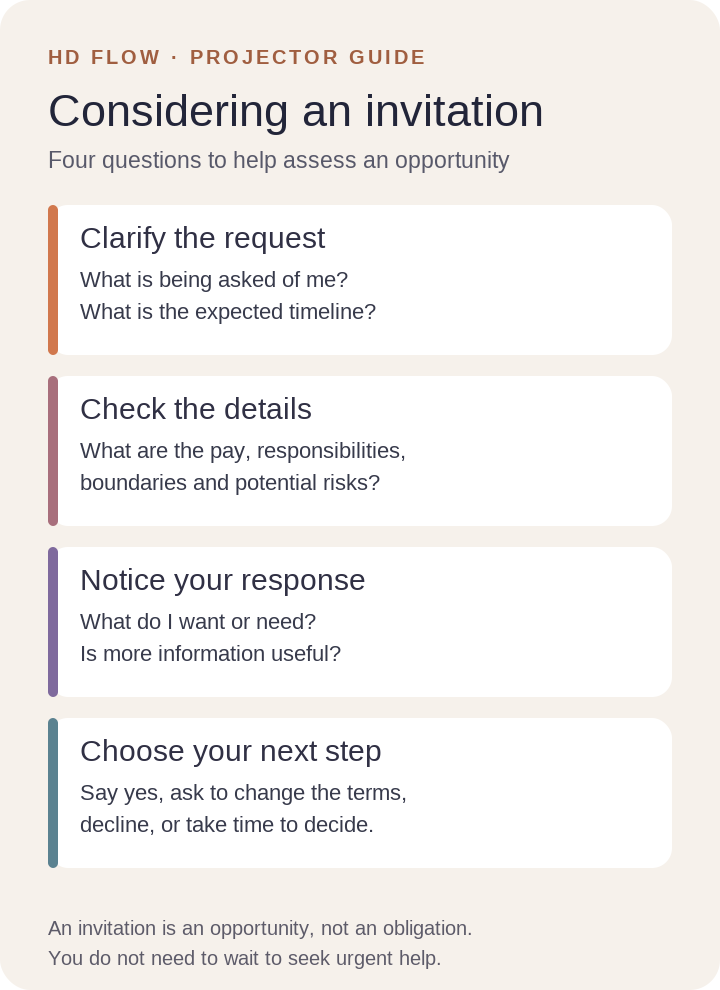
1. Clarify the request. Ask what the person wants, what you would do and when they expect an answer. 2. Check the practical details. Consider pay, time, responsibilities, support and any costs or risks. 3. Notice your own response. You might reflect, write things down or talk with someone you trust. 4. Make your choice. You can say yes, ask to adjust the terms, or say no.
Human Design teachers may also discuss a Projector's inner authority, which depends on the chart. Whatever method you use to reflect, consider evidence, your circumstances and professional advice when relevant.
Does a Projector have to work fewer hours?
No chart establishes a safe or ideal number of working hours. Needs vary by person, health, job conditions and other circumstances. It can be useful for anyone to review workload, breaks and support. If fatigue or sleep problems persist, a healthcare professional can help identify possible causes.
The Projector career guide includes a practical checklist for comparing roles, hours and compensation.
What about bitterness?
Human Design calls bitterness the Projector's “not-self theme.” You can use that phrase to reflect on a disappointing situation if it resonates, but feeling bitter does not prove you failed to follow a chart or identify the cause. Consider the circumstances, relationships and support available to you.
Frequently asked questions
Do Projectors have to wait for permission to do everyday things?
No. Everyday decisions, asking questions, seeking help and taking care of yourself do not require an invitation.
Must I accept every invitation?
No. An invitation is an opportunity to consider, not an obligation. Ask questions and choose based on your needs and circumstances.
Should I delay urgent medical care or safety decisions?
No. Seek urgent help when needed; you do not need to wait for an invitation, a specific feeling or a chart reading.
Can I calculate my Projector chart on HD Flow?
Use the free Human Design chart calculator to calculate your chart in your browser. The Projector type guide and three Projector groupings explain the terminology.
Sources and related reading
- Type and Strategy in Human Design, Jovian Archive.
- What Is Inner Authority?, Jovian Archive.
- Projector careers and Projector recognition and invitations, HD Flow.
See this in your own chart
Reading about the mechanics is one thing — seeing them mapped onto your own bodygraph is what makes it click. Your free chart shows your type, strategy, authority, profile, defined centers, channels and gates.