Projector Careers: How to Compare Work, Hours and Opportunities
Explore career options, compare schedules and compensation, and learn what Human Design can and cannot tell you about work.
Short answer: There is no scientifically validated list of jobs for Projectors or a universal number of hours they can work. If Human Design's Projector description resonates with you, use it as a prompt to consider the work you enjoy, the conditions you need, and how an opportunity fits your life.
A Projector is one of Human Design's types. The system associates the type with recognition and invitation for significant opportunities; Jovian Archive describes that teaching. It is an interpretive framework, not a test of career aptitude, stamina, mental health or earning potential.
What does “wait for an invitation” mean at work?
Human Design writers often use the phrase for substantial opportunities where someone recognizes your contribution and asks you to participate. In practical terms, you can still apply for a job, network, pitch clients, start a business, negotiate pay and ask for a promotion. You do not need to wait for permission to pursue work.
When an employer or client expresses interest, ask what the role actually involves: What results are expected? Who makes decisions? What resources are available? How will your work be evaluated and paid? Recognition alone does not make an offer suitable.
See the recognition and invitations guide for more on the distinction.
Careers to explore based on your interests
These are examples to research, not jobs a chart can assign or guarantee. Conditions, qualifications, compensation and schedules differ by employer and location.
| If you enjoy... | Roles to investigate | Questions to ask |
|---|---|---|
| Improving systems | Management analyst or operations specialist | Does the role involve travel, deadlines or long hours? What experience is expected? |
| Building and testing tools | Software developer or quality assurance analyst | How much collaboration, on-call work or training is involved? |
| Supporting people at work | Human resources specialist or recruiter | Is the work focused on interviews, administration, conflict resolution or sales targets? |
| Teaching or advising | School or career counselor | What degree, supervised experience or state credential does the role require? |
| Creative or independent work | Writer, designer, tradesperson or business owner | How predictable is the income, and who handles sales, administration and benefits? |
The U.S. Bureau of Labor Statistics' Occupational Outlook Handbook describes duties, typical education, working conditions and pay for many occupations. O*NET OnLine also lets you explore occupations by interests, skills and job requirements.
A Projector can pursue hands-on, analytical, creative, service or leadership work. Skills, interests, experience, accessibility needs, finances and the actual workplace matter more than a chart label.
How to compare two opportunities
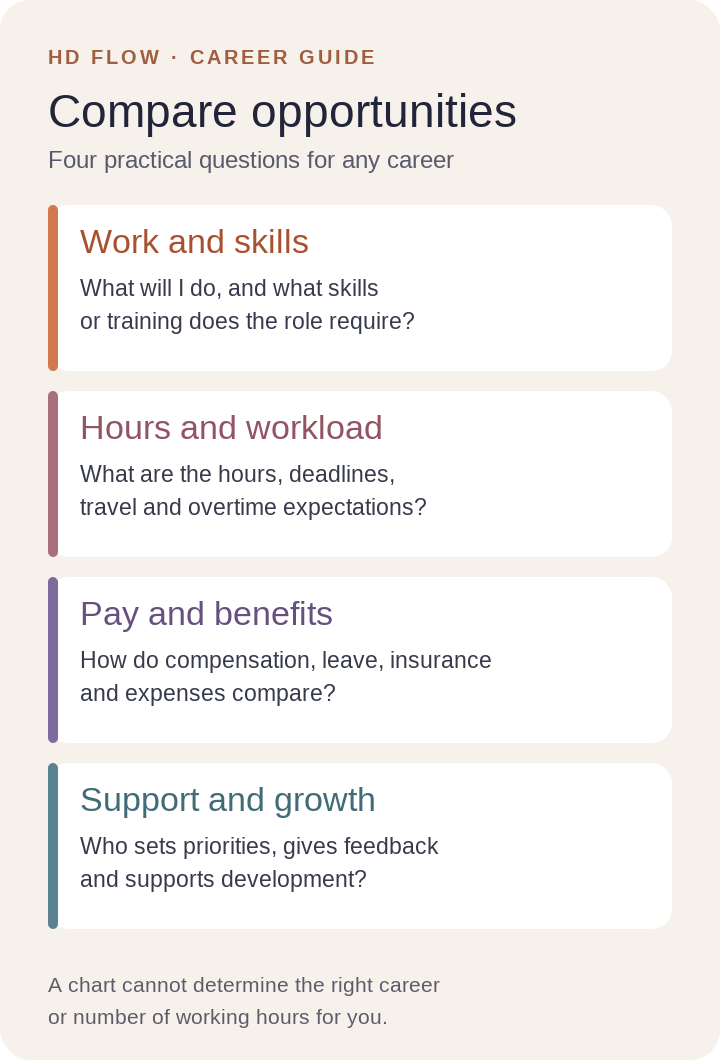
Before accepting an offer or changing careers, write down what matters most to you and compare each option:
1. Work itself: Which tasks would fill a normal week? Are they tasks you want to learn and do? 2. Schedule and workload: What are the hours, busy seasons, travel expectations, interruptions and overtime practices? 3. Pay and benefits: Compare compensation, insurance, paid leave, retirement benefits and any unpaid time. For independent work, include taxes and business expenses. 4. Support and decision-making: Who sets priorities, provides feedback and has authority to make changes? 5. Training and risk: What qualifications are required, how much will they cost, and what alternatives do you have if the role does not work out?
If possible, talk with someone doing the job, read several current job postings, and ask the hiring manager about a typical week. An appealing title may hide an unsuitable schedule; a less obvious title may offer the conditions you want.
How many hours should a Projector work?
There is no evidence that a Human Design type determines an ideal daily or weekly number. Some people prefer or need full-time work; others need or want a shorter or more flexible schedule. Consider your responsibilities, finances, health, actual workload and preferences.
If you are consistently exhausted, look at the whole situation: workload, sleep, stress and possible health concerns. A qualified health professional can help with persistent fatigue. A chart cannot diagnose burnout or determine its cause.
Building visibility without waiting passively
You can make your skills easier to understand without assuming a particular outcome:
- Update your résumé or portfolio with specific work, responsibilities and results you can substantiate.
- Ask colleagues, clients or mentors for feedback and introductions.
- Apply for roles that match your interests and qualifications, and follow up where appropriate.
- Ask prospective clients or employers about scope, compensation, decision-making and expectations.
- Keep a financial plan while exploring a change; independent work may involve irregular revenue and added expenses.
These steps do not guarantee an invitation or offer, but they give you useful information and ways to pursue opportunities.
Frequently asked questions
Can a Projector work a full-time job?
Yes. A chart label does not determine whether someone can work a particular schedule. Evaluate the role and your own circumstances.
Do Projectors have to be coaches or consultants?
No. Those are options among many. Some counseling and related professions require specific education or credentials; check the occupation and your state's requirements.
Should I quit a job that does not feel recognized?
A lack of feedback or support may be worth addressing, but a chart cannot decide whether to leave. Consider your options, finances, benefits and support before making a change.
Can a chart tell me why I am burned out?
No. Human Design is not a diagnostic tool. Consider workplace conditions and speak with a qualified professional about ongoing symptoms or concerns.
Can I calculate my chart here?
Use the free Human Design chart calculator to calculate your chart in your browser. The Projector type guide and authority overview explain the labels.
Sources and further reading
- What is a Projector?, Jovian Archive, for the Human Design terminology.
- Occupational Outlook Handbook, U.S. Bureau of Labor Statistics.
- Find Occupations, O*NET OnLine.
- Recognition and invitations, Projector authority, and Projector type, HD Flow.
See this in your own chart
Reading about the mechanics is one thing — seeing them mapped onto your own bodygraph is what makes it click. Your free chart shows your type, strategy, authority, profile, defined centers, channels and gates.