Human Design Morning Routine: A Flexible Guide for Every Type
Build a practical morning routine around your schedule, sleep and preferences, with optional Human Design reflection prompts.
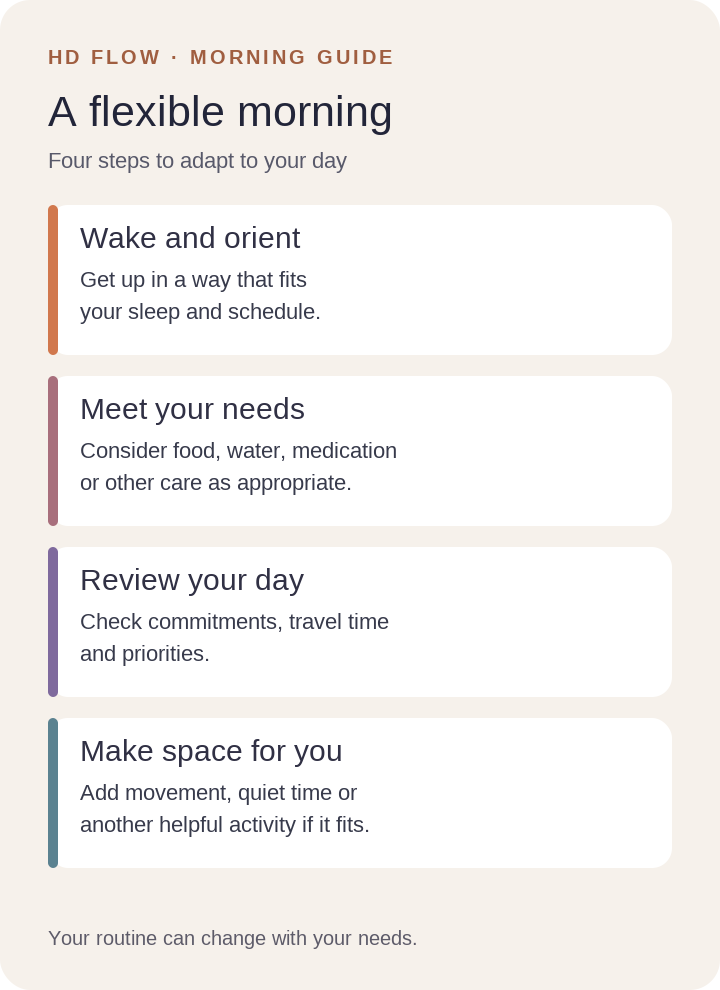
Short answer: A morning routine can be shaped around your schedule, sleep, responsibilities and preferences. Human Design may offer prompts for reflection, but there is no established evidence that a chart determines the best wake-up time, exercise routine or decision schedule.
A routine does not need to be elaborate. Start with the time you have and adjust based on what helps you feel prepared, supported and rested.
Build around sleep and your actual schedule
A consistent sleep and wake schedule can support sleep; the CDC's sleep guidance offers age-based recommendations and practical habits. Shift work, caregiving, school and health needs can make consistency difficult, so aim for a realistic routine rather than a perfect one.
If you regularly wake unrefreshed or struggle with daytime sleepiness, speak with a healthcare professional. See Human Design and sleep for more.
A flexible morning checklist
| Step | Options to consider |
|---|---|
| Wake and orient | Allow a little time to get up; an alarm is fine if your schedule requires one. |
| Meet basic needs | Consider water, breakfast, medication or other care as appropriate for you. |
| Review the day | Check your commitments, travel time and priorities. |
| Add something useful | If it fits, try gentle movement, quiet time or a short walk. |
| Adjust | Change or skip a step when the routine is not working. |
Food, hydration, exercise and medication needs differ. Follow your own healthcare guidance and avoid treating a general checklist as a prescription.
Can I use my Human Design type?
If you enjoy the framework, you can treat a type description as a question rather than a rule. For example:
- Generator or Manifesting Generator: What activities or options interest me today?
- Projector: What support or boundaries would help with my commitments?
- Manifestor: What plans do I want to communicate to people affected by them?
- Reflector: What setting helps me think or feel comfortable?
These questions are available to anyone. No type establishes your ideal working hours, how much rest you need or whether you should wait for an invitation before starting your day. Read the Projector guide and Sacral guide for context.
What about decisions in the morning?
You can make a decision whenever the situation requires it. Some Human Design teachers discuss taking time with Emotional authority or using a sounding board for certain charts; neither establishes that you must wait until noon or follow a fixed schedule.
For a consequential decision, consider the deadline, relevant information and professional advice when needed. Do not delay urgent care or safety decisions for a chart-based routine. See Emotional authority.
Make the routine fit you
Try one change for a few days and notice whether it helps. A short routine might be getting dressed, checking the calendar and eating if you are hungry. A longer one could include a walk or journaling. There is no required length, wake-up time or phone-free period.
Avoid comparing your routine with someone else's highlight reel. The goal is a useful start to *your* day.
Frequently asked questions
Must a Projector have a slow morning?
No. A chart does not determine a person's pace or schedule.
Should someone with Emotional authority avoid decisions before noon?
No. There is no scientifically established rule that chart authority dictates a time of day for decisions.
What if I cannot wake without an alarm?
An alarm can be a practical tool. Allow enough time for sleep when possible, and seek advice for persistent sleep difficulties.
Sources and related reading
- About Sleep, Centers for Disease Control and Prevention.
- Human Design and sleep, Emotional authority, and what Human Design is, HD Flow.
See this in your own chart
Reading about the mechanics is one thing — seeing them mapped onto your own bodygraph is what makes it click. Your free chart shows your type, strategy, authority, profile, defined centers, channels and gates.