Human Design and Careers: A Practical Guide for Every Type
Compare careers by tasks, pay, training and work conditions, with questions for every Human Design type.
Short answer: Human Design can be a reflection prompt when thinking about work, but a chart cannot determine the right career, how many hours you can work or whether a job will be satisfying. Compare opportunities using your interests, skills, financial needs, health, qualifications and the actual terms of the role.
There is no scientifically validated connection between Human Design type and job performance or career fit. People of any type can work in any field.
Start with the work, not the label
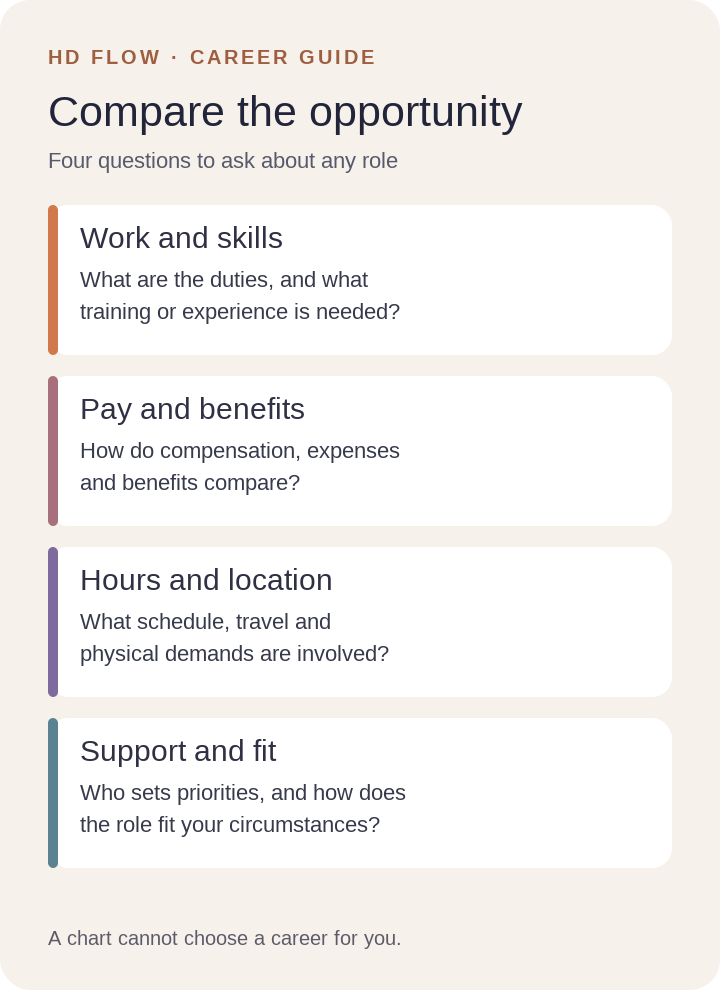
Before comparing job titles, consider what a normal week would involve:
- Tasks and skills: What would you do, and what training or experience is needed?
- Compensation: What are the pay, benefits, expenses and advancement opportunities?
- Schedule: What hours, travel, shifts, deadlines and flexibility are expected?
- Workplace: Who sets priorities, gives feedback and provides support?
- Fit with your life: How do the location, physical demands and responsibilities fit your circumstances?
The Bureau of Labor Statistics Occupational Outlook Handbook describes duties, typical entry requirements, pay and job outlook for many occupations. National figures are not a guarantee for a particular job or location.
Explore real career examples
The same occupation can include different roles, schedules and work environments. These examples are starting points for anyone, regardless of chart type:
| Occupation | What to investigate | BLS profile |
|---|---|---|
| Software developer | Skills and training, collaboration, remote-work expectations | Software developers |
| Project management specialist | Responsibility for timelines, budgets and coordinating people | Project management specialists |
| Registered nurse | Education and licensing, setting, shifts and physical demands | Registered nurses |
| Electrician | Apprenticeship, licensing rules, work sites and physical demands | Electricians |
Read the profile and research local licensing, employers and openings before making a commitment. A Human Design chart does not establish who will succeed in any of these careers.
Can type be a useful reflection prompt?
If Human Design interests you, you might use its language to frame questions, without treating the answers as fixed:
| Type | A question anyone could consider |
|---|---|
| Generator | Which tasks interest me, and what does the role actually require? |
| Manifesting Generator | Do I prefer variety, focus or a mix in this particular role? |
| Projector | What support, responsibilities and workload would help me do good work? |
| Manifestor | How much independence and coordination does this position involve? |
| Reflector | How do the people, location and workplace conditions fit my needs? |
These questions are not exclusive to a type. A Projector can work a conventional schedule; a Manifesting Generator can enjoy one specialty; a Reflector can thrive in many kinds of work. Ask the person rather than assuming from a chart.
How to compare an actual offer
1. Read the full terms. Ask about base pay, variable compensation, benefits, location, schedule and responsibilities. 2. Check the practical costs. Include commuting, training, childcare, equipment or other expenses where relevant. 3. Ask about support. Who manages priorities and how is success evaluated? 4. Confirm the deadline. Request time or clarification if you need it, but decide within the time available. 5. Consider the whole picture. Seek qualified financial, legal or professional advice when appropriate.
A first impression or chart interpretation can be one reflection prompt; it does not replace reviewing the offer. You do not need to wait a fixed number of hours or a lunar cycle to decide.
Changing careers without making a sudden leap
You might compare job postings, speak with people working in a field, take a course or test a skill before leaving your current role. Consider savings, benefits and obligations when deciding how much risk to take. There is no guaranteed timeline for finding a good fit.
Frequently asked questions
What is the best career for my Human Design type?
There is no validated list. The best fit depends on the person, the role and the circumstances.
Can my chart tell me how much I can work?
No. A chart does not measure stamina or determine a safe schedule. Discuss persistent fatigue or health concerns with a qualified professional.
Can I calculate my chart on HD Flow?
Use the free Human Design chart calculator to calculate your chart in your browser. Estimated birth times can make results provisional.
Sources and related reading
- Occupational Outlook Handbook, U.S. Bureau of Labor Statistics.
- Projector careers, Generator guide, and morning routines, HD Flow.
See this in your own chart
Reading about the mechanics is one thing — seeing them mapped onto your own bodygraph is what makes it click. Your free chart shows your type, strategy, authority, profile, defined centers, channels and gates.