Sacral Response in Human Design: A Practical Guide
Learn what Human Design means by sacral response, how Sacral and Emotional authority differ, and how to use the idea for reflection.
Short answer: In Human Design, a sacral response is a way teachers describe an immediate bodily response to something encountered or a question asked. It is associated with Generators and Manifesting Generators, who have a defined Sacral Center in the system.
Human Design is an interpretive framework. Its claims about bodily responses and decision-making are not scientifically validated, and a sensation is not proof that a choice is safe or right.
What is the Sacral Center?
A Human Design chart uses nine named centers. The Sacral Center is described within the system as a motor associated with work and life force. These are symbolic chart terms, not medical descriptions of the body or measures of how much energy a person has.
A defined Sacral is part of the chart definition of a Generator or Manifesting Generator. It does not establish that someone has unlimited stamina, will enjoy every task or needs to exhaust themselves before sleeping.
What do teachers mean by a response?
Teachers often give examples of a response to a specific question or situation, such as an “uh-huh,” an “uh-uh,” or uncertainty. Some people notice a physical sensation; others do not. You do not have to produce a sound or assume an ambiguous feeling is a definite answer.
Jovian Archive's guide to Generator misconceptions describes these responses as part of the Human Design framework.
Sacral response versus inner authority
Having a defined Sacral does not mean every Generator or Manifesting Generator has Sacral authority. Within Human Design, a defined Solar Plexus indicates Emotional authority, which takes priority in the system's authority hierarchy. Sacral authority is associated with a defined Sacral and an undefined Solar Plexus.
| Chart description | Authority in Human Design teaching |
|---|---|
| Defined Sacral and defined Solar Plexus | Emotional authority; teachers discuss decisions over time. |
| Defined Sacral and undefined Solar Plexus | Sacral authority; teachers describe responding to what is present. |
See what inner authority means and the HD Flow authority guide. These labels are not evidence that one decision method is objectively better for you.
A practical reflection exercise
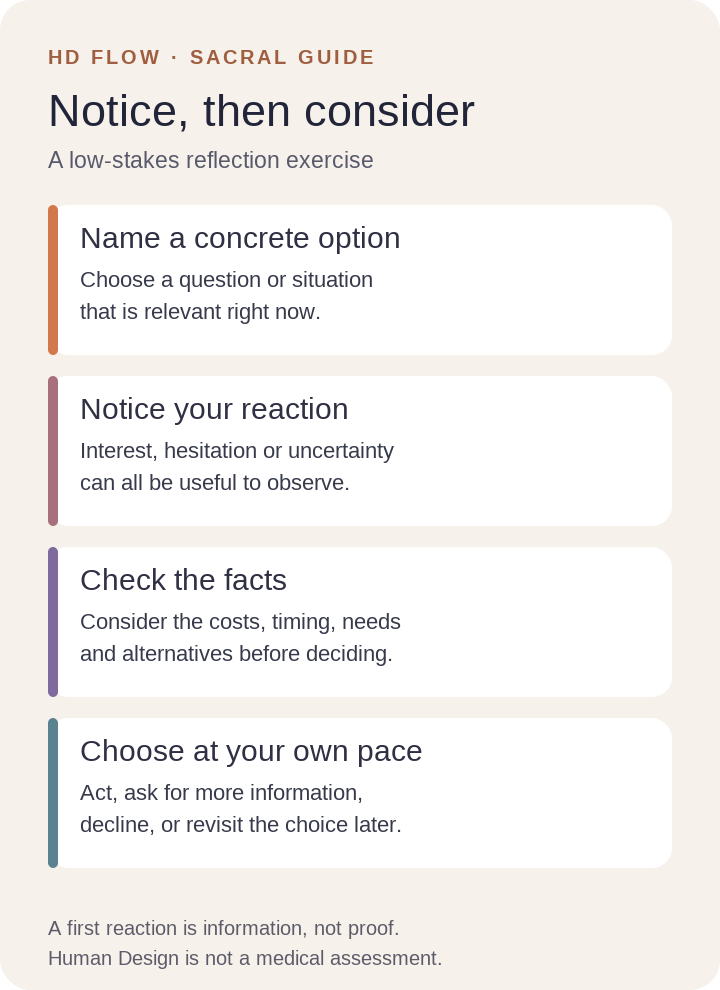
If you find this approach interesting, try it with a low-stakes choice:
1. Name a concrete option. For example, “Do I want to try this class?” 2. Notice your first reaction. It may be interest, hesitation, uncertainty or no particular feeling. 3. Check the facts. Consider cost, timing, accessibility and other options. 4. Decide at an appropriate pace. Ask for more information, try it, decline or revisit it later.
A first reaction is information, not a verdict. For consequential choices, weigh evidence and seek relevant professional advice.
Frustration, rest and sleep
Human Design describes frustration as a Generator and Manifesting Generator “not-self theme.” Frustration can have many causes; it does not prove that you ignored a sacral response.
There is no evidence that a chart tells you how much activity you need or that Generators should exhaust themselves to sleep. Rest and sleep needs vary. Persistent fatigue or sleep difficulties deserve appropriate medical attention.
Frequently asked questions
Do all Generators have Sacral authority?
No. In Human Design, Generators with a defined Solar Plexus have Emotional authority; a defined Sacral alone does not settle the authority question.
Is the first gut feeling always correct?
No. First impressions can be useful to notice, but they can also be mistaken. Consider context and relevant evidence.
Can a chart diagnose fatigue or tell me how to sleep?
No. A chart is not a medical assessment. Seek qualified care for persistent symptoms or concerns.
What if I do not know my birth time?
A chart calculated from an estimated birth time is provisional because some chart elements may change with different inputs. Use the free Human Design chart calculator to calculate your chart in your browser. For help reading the result, see what Human Design is.
Sources and related reading
- Debunking myths about Generators and the Sacral Center, Jovian Archive.
- What Is Inner Authority?, Jovian Archive.
- Generator type, Sacral authority, and Generator frustration, HD Flow.
See this in your own chart
Reading about the mechanics is one thing — seeing them mapped onto your own bodygraph is what makes it click. Your free chart shows your type, strategy, authority, profile, defined centers, channels and gates.