The Six Human Design Profile Lines Explained
Learn the six line names, how two lines form a profile, and how to read 1/3 and 4/6 examples.
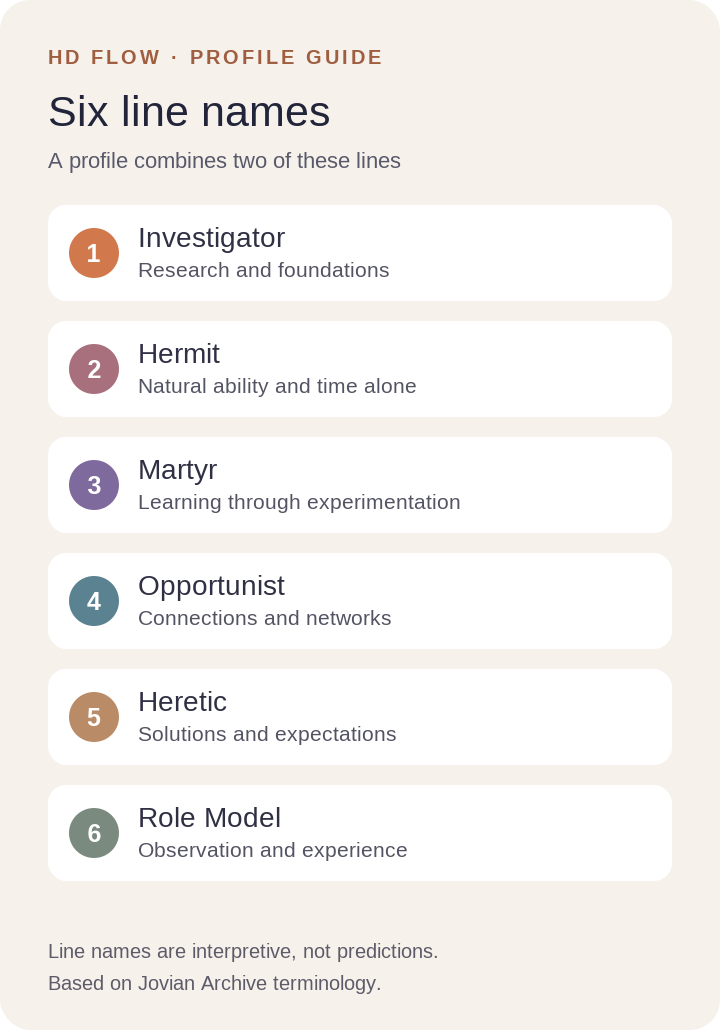
Short answer: A Human Design profile combines two line numbers, such as 1/3 or 4/6. The system assigns themes to each of six lines, and the pair forms one of 12 profile labels.
Profile descriptions are part of an interpretive framework. They are not scientifically validated personality assessments and do not establish a person's abilities, relationships or future.
Where do the two numbers come from?
Within Human Design, the first number is the line of the Personality Sun/Earth; the second is the line of the Design Sun/Earth. These are commonly called conscious and unconscious, respectively. Jovian Archive's profile explanation describes the two sources.
“Conscious” and “unconscious” are labels in the system; they do not prove which traits a person notices in themselves. A birth-time estimate may change a chart's profile, so treat estimated results as provisional.
The six line names
| Line | Common name | Theme discussed in Human Design teaching |
|---|---|---|
| 1 | Investigator | Research and foundations |
| 2 | Hermit | Natural abilities and time alone |
| 3 | Martyr | Learning through experimentation |
| 4 | Opportunist | Connections and networks |
| 5 | Heretic | Practical solutions and others' expectations |
| 6 | Role Model | Observation, experience and example |
Names and interpretations can differ by teacher. “Martyr,” “Hermit” and “Heretic” are traditional labels; they do not mean someone must suffer, avoid people or challenge beliefs. These themes are not forecasts or requirements.
Example: reading a 1/3 profile
In a 1/3 chart, the first number is Line 1 and the second is Line 3. A Human Design reader may discuss investigation alongside experimentation. The label does not establish that the person must research every decision or learn only by trial and error.
See the 1/3 profile guide for the system's terminology.
Example: reading a 4/6 profile
In a 4/6 chart, the first number is Line 4 and the second is Line 6. Teachers may discuss relationships and networks alongside the Role Model theme. A 4/6 profile is different from a 4/1 profile; it does not establish a fixed fate or predict what will happen at a particular age.
Read the 4/6 profile guide.
What about the sixth line's life phases?
Some Human Design teachers describe a sixth-line process in phases. People may find that metaphor meaningful, but the chart does not establish a mandatory timeline or guarantee how someone's life will unfold. People change, learn and contribute at many ages.
How to explore your profile
1. Find the profile label on an existing chart and check your birth information. 2. Read both line descriptions, paying attention to the provider's terminology. 3. Ask whether a prompt resonates without assuming it must fit. 4. Keep your own experiences, preferences and circumstances in view.
You do not need to reshape your life around a profile label. Look for the two numbers under Profile in the free Human Design chart calculator, then read the matching profile guide.
Frequently asked questions
Are there six lines or 12 profiles?
Human Design describes six line themes and 12 standard profile combinations.
Is my profile a validated personality test?
No. Human Design profile interpretations have not been scientifically validated as personality assessments.
Do all people with the same profile live alike?
No. A shared chart label does not determine a person's personality, circumstances or life trajectory.
Can I calculate a profile without my exact birth time?
A chart calculated from an estimated time is provisional because line placements can change with different inputs.
Sources and related reading
- The Six Lines of the Hexagram and Understanding Your Profile, Jovian Archive.
- All 12 profiles, 1/3 and 4/6, HD Flow.
See this in your own chart
Reading about the mechanics is one thing — seeing them mapped onto your own bodygraph is what makes it click. Your free chart shows your type, strategy, authority, profile, defined centers, channels and gates.