Human Design and Parenting: Supporting Your Child as an Individual
Explore Human Design as a conversation starter while supporting your child's individual needs, choices and development.
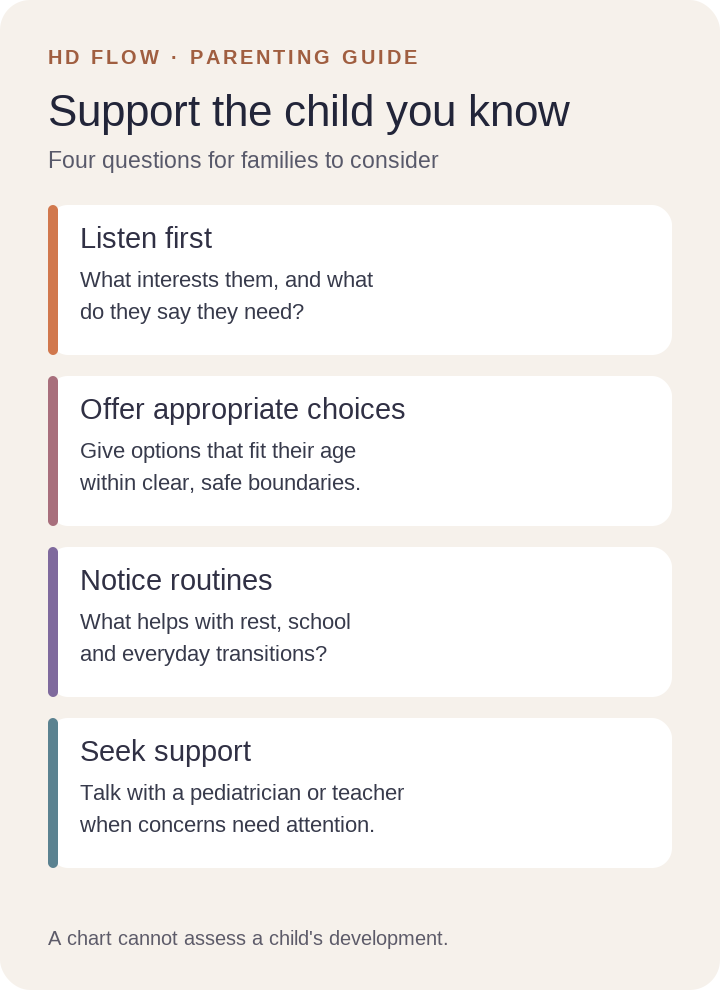
Short answer: If your family enjoys Human Design, a chart can be a conversation starter. It cannot reliably measure your child's personality, development, stamina, learning needs or future. Get to know the child in front of you, and use age-appropriate guidance and professional support when needed.
Human Design is an interpretive framework; its claims about type and personality are not scientifically validated. Children develop at different rates, and no chart should be used to diagnose a condition or restrict access to school, activities or care.
Start with your child's actual needs
Instead of assuming a child needs a particular schedule or approach because of a chart, ask what you observe:
- What interests them, and what do they want to try?
- How are they sleeping, eating, learning and interacting with others?
- What support helps them feel safe and understood?
- Which expectations are appropriate for their age and circumstances?
Listening to a child's preferences does not mean removing boundaries or letting them make every decision. Adults still make safety and healthcare decisions and provide structure.
What about the five Human Design types?
Human Design uses the terms Generator, Manifesting Generator, Projector, Manifestor and Reflector. Some families find the descriptions helpful as prompts, but they are not evidence that a child has a fixed energy level, temperament or path.
| A question a parent might ask | A practical way to respond |
|---|---|
| Does my child need rest? | Notice their individual cues and routines; ask a pediatrician about persistent fatigue or sleep concerns. |
| Do they want more choice? | Offer age-appropriate options within safe limits. |
| Are they hesitant about an activity? | Listen, ask what feels difficult, and explore support or alternatives. |
| Are they having trouble at school? | Talk with the child, teacher and qualified professionals rather than attributing it to a type. |
For example, a Projector label does not establish that a child has less stamina or cannot manage school. A Manifestor label does not predict future anger. A Reflector label does not prove a child absorbs other people's feelings.
Offer choices and clear boundaries
For young children, a limited choice can encourage independence while keeping a necessary routine intact: “Would you like the blue shirt or the red shirt?” The CDC's guidance for toddlers and preschoolers discusses giving clear directions and offering appropriate choices.
For older children, invite more discussion about options and consequences as their ability and circumstances allow. It's reasonable to adapt your approach to the child, rather than treating one communication style as required by a chart.
Routines, rest and school
Predictable routines and clear expectations can help children know what to expect. The CDC's child development guidance discusses supportive relationships, routines and household rules.
Sleep needs vary by age and individual. If you have concerns about tiredness, sleep, learning, behavior or development, talk with your child's pediatrician and, where relevant, their teacher or school support team. A chart cannot replace a developmental assessment, diagnosis or educational evaluation.
If your child enjoys Human Design
You might ask, “Does this description feel like you?” and make room for disagreement. A child can change interests, develop skills, and describe their own experience differently over time. Avoid presenting a label as a reason they cannot do something.
Birth details are personal information. Before entering a child's data into any service, review its privacy practices and how information may be stored or shared. Use the free Human Design chart calculator to calculate your chart in your browser.
Frequently asked questions
Can a Human Design chart diagnose ADHD or another condition?
No. A chart is not a diagnostic tool. Discuss concerns with a qualified healthcare professional.
Should my child's type determine their school or activities?
No. Consider the child's interests, needs, opportunities, safety and any professional or school guidance.
Can I offer choices while keeping a firm boundary?
Yes. For example, a caregiver can require a safety step while offering age-appropriate choices about how to complete it.
Sources and related reading
- Healthy Habits: Child Development, Centers for Disease Control and Prevention.
- Tips for Giving Directions, CDC guidance for toddlers and preschoolers.
- About Sleep, CDC age-based sleep recommendations.
- What is Human Design? and the 12 profiles, HD Flow.
See this in your own chart
Reading about the mechanics is one thing — seeing them mapped onto your own bodygraph is what makes it click. Your free chart shows your type, strategy, authority, profile, defined centers, channels and gates.